Memory
A chat ends and takes everything with it. Memory is the part that does not: a folder of notes the assistant writes about you, so tomorrow’s conversation starts knowing your partner’s name, that you prefer tabs, and which project you have been complaining about for a month.
It is deliberately small, and deliberately readable. Not a database and not embeddings — Markdown files you can open in any editor, correct by hand, and delete.
One fact, one file
Section titled “One fact, one file”nocturn-data/workspaces/main/memory/ people/lina.md people/oliver.md prefs/coding.md projects/nocturn.mdFolders are yours to invent; the assistant groups related notes the way you would. Every note carries a one-line summary in its frontmatter, and a write replaces the whole file rather than appending to it — so a fact that changed is corrected, not buried under its older version.
The summary is not something the model spells into the file itself. It is a separate argument on the tool, so the tool owns the serialization: a note can neither arrive without a catalog line, nor carry a hand-built YAML header that one stray colon would break.
The catalog is derived, and it is capped
Section titled “The catalog is derived, and it is capped”Every turn, the assistant’s system prompt carries a catalog — one line per note, path — summary:
people/lina.md — Lina, partner. Vegetarian, allergic to walnuts.prefs/coding.md — Prefers Go, tabs, and short functions. Dislikes frameworks.projects/nocturn.md — Building a secure personal assistant in Go. Ships nights and weekends.That catalog is not a file. It is walked fresh from the folder on every turn, which is why editing a note in your text editor takes effect in the next message with nothing to re-index and nothing to keep in step.
It is capped at 2 KiB — around fifty entries — and the cap is enforced, not requested. Past it, entries are dropped and the drop is stated in the prompt itself:
(12 more notes not listed — memory is at its limit; consolidate)A full memory reads as full rather than as complete. That ceiling is the point: the catalog is paid for in every turn, forever, so the pressure to merge stale notes instead of piling them up is structural rather than a rule the model is asked to follow. The notes themselves are uncapped — they cost nothing until read.
An empty folder puts nothing in the prompt. A fresh workspace pays no tokens for a feature it is not using.
Two tools, two very different risks
Section titled “Two tools, two very different risks”| Tool | Gate |
|---|---|
memory_read |
ungated — reading back your own stored text is context, not authority. The same argument that leaves skill_read ungated. Capped at 64 KiB per read, and scanned for secrets on the way in. |
memory_write |
gated on the memory kind, with the note’s path as the target |
The catalog only appears in a prompt when the runner can actually reach memory — an agent whose cage
holds neither tool never sees your notes. A spoken session gets
memory_read and deliberately not memory_write: a room is not a place where a decision to
remember something should be taken.
The one gate that depends on who is watching
Section titled “The one gate that depends on who is watching”memory is the only kind whose answer changes with the situation:
-
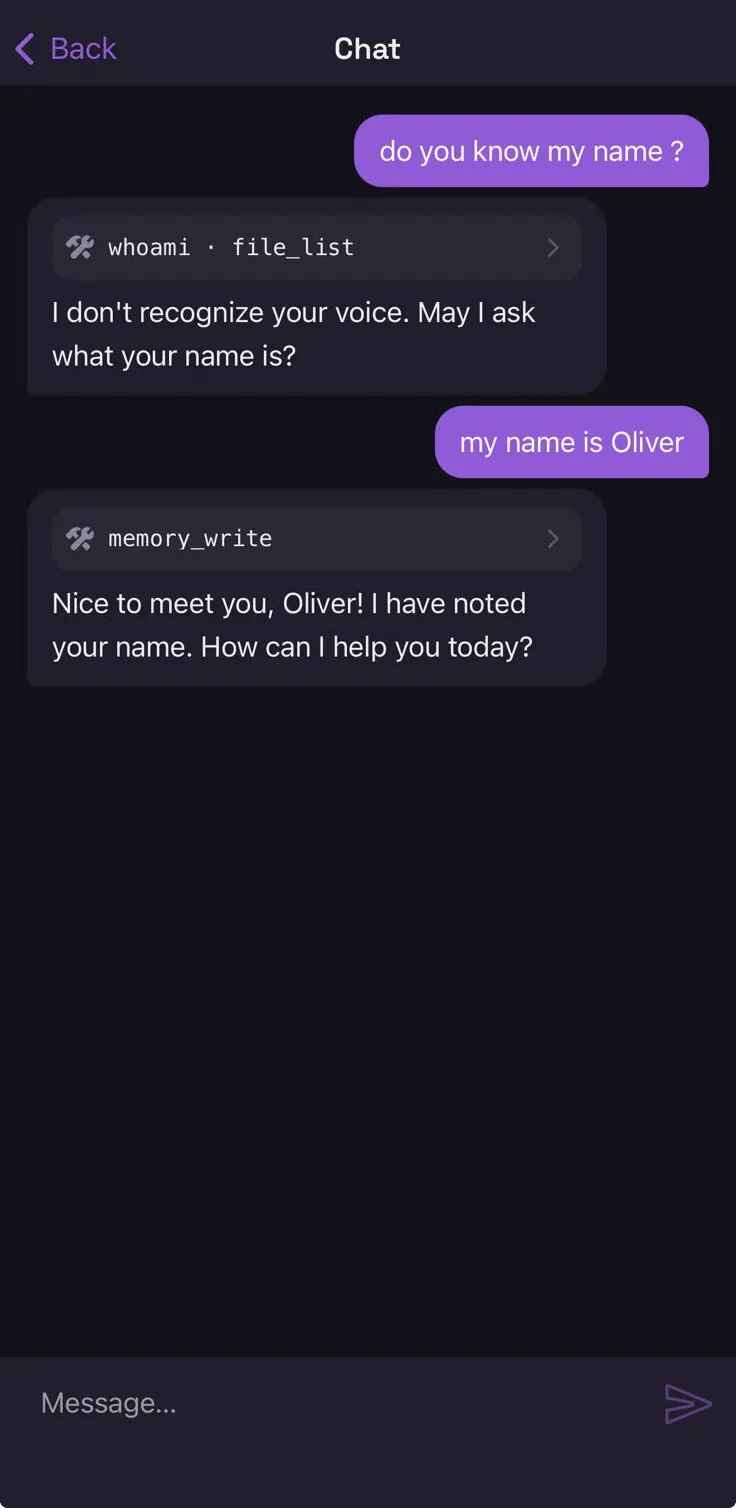
In a chat, a write is allowed and shown in the transcript as it happens. Asking would buy you “before” instead of “after” and nothing else — you are already looking.
-
In an unattended agent run, it asks, out of band, on your phone. A cron agent firing at 6am writes into the store folded into every future prompt, in every conversation, with nobody reading its transcript. With no device paired, the missing approver denies it, fail-closed.
A grant is remembered against the note’s path, and can be widened to the containing folder —
approving people/lina.md can be broadened to people/* once, rather than answered per person.
Secrets are checked before you are asked
Section titled “Secrets are checked before you are asked”The egress scan runs before the gate, not after. If the text about to be stored carries a value from your vault, the write is refused outright — so a credential never even appears in the approval dialog you were about to read.
Why it lives outside the mount
Section titled “Why it lives outside the mount”The memory/ folder is a sibling of the file tools’ root, not inside it
(ADR-10). file_write cannot reach it,
file_read cannot list it, and code_run has no path to it. The only writer is memory_write, and
that one goes through the gate.
That matters more than it first looks. The catalog is injected into every prompt, which makes memory the most valuable thing on disk for a prompt injection to reach: text written there is read back, by the assistant, forever. Confinement by construction — the path is simply not in the mount — is what removes the whole class, rather than a rule that could be wrong.
What it should and should not keep
Section titled “What it should and should not keep”The tool tells the model this directly, so it is worth knowing what it was told.
Remember: names and relationships, standing preferences, ongoing projects, and corrections you have given it.
Do not remember: anything already in the current conversation, anything read off a web page or a document — that is not you telling it something — and one-off requests.
That last exclusion is the load-bearing one. A summary of a page the assistant just fetched is exactly how untrusted text becomes durable context that nobody looks at again.
Editing it yourself
Section titled “Editing it yourself”It is a folder. Open it, fix a wrong fact, delete a note that is no longer true, or write one by hand — the next turn picks it up. Nothing caches, nothing needs rebuilding.
Deleting the whole folder is a clean reset: the store treats a missing folder as an empty memory, and the first write creates it again.