Agents
An agent is a job you hand off. You describe what it should do and which tools it may use, then let it run — from the chat, or on a schedule. What happens when it wants to do something that needs a human is decided in advance, by one setting, and the safe value is the one you get by forgetting to set it.
Define an agent
Section titled “Define an agent”An agent is a folder in your workspace with one file, agent.md: a YAML settings block, then the
brief in plain language.
---name: morning-briefingdescription: Summarize my inbox and today's headlinestools:  - http_read  - file_writeautonomy: guardedwhen: "0 7 * * *"effort: highbudget: 5m---
Read my inbox in mnt/inbox.txt and the headlines from the news sites I follow.Write a short summary to mnt/briefing.md. Keep it under ten bullet points.| Field | What it does |
|---|---|
name |
Optional. The folder name is the identity; a differing name here warns, and the folder wins. |
description |
One line, shown by /agents and nocturn ls. |
tools |
The agent’s cage — the tools it has at all. Anything not listed does not exist for it. |
when |
A five-field cron expression, "0 7 * * *", to run on a schedule. Leave it out to run only when asked. |
autonomy |
strict (default) or guarded. See below. |
effort |
Reasoning effort: low, medium, high, xhigh — endpoint-dependent. |
budget |
A Go duration (5m, 90s) bounding the run. |
Two failures are deliberately loud: a budget that does not parse and an autonomy that is not one
of the two values are hard errors, and the agent is skipped rather than run with the wrong bound
or a looser dial than you meant. Unknown fields are ignored — so a model: line does nothing today.
How independent it is
Section titled “How independent it is”autonomy decides what happens when an agent, running with no human in front of it, hits an action
the gate wants to ask about:
| Setting | What happens |
|---|---|
strict (default, and the zero value) |
No approver is wired. The ask is denied, and the run says so. |
guarded |
The ask is routed out of band — a push wakes your phone, and the run waits for your answer. |
There is no third setting, and in particular there is no “just do it”. The most an agent can be granted is the right to ask you somewhere else.
Note what strict being the zero value buys: a missing dial, a typo’d file, an agent you forgot to
configure — all of them fail toward less authority. And guarded with no paired device collapses
back to strict, because there is nobody to ask. Setting up remote approval is what adds
capability; skipping it never silently grants any.
Run it
Section titled “Run it”From the chat:
/agents # list them/fire morning-briefing check only the inbox # run one now, with a one-off taskThe run happens in the background and streams into your terminal marked with its run id, while you keep typing.
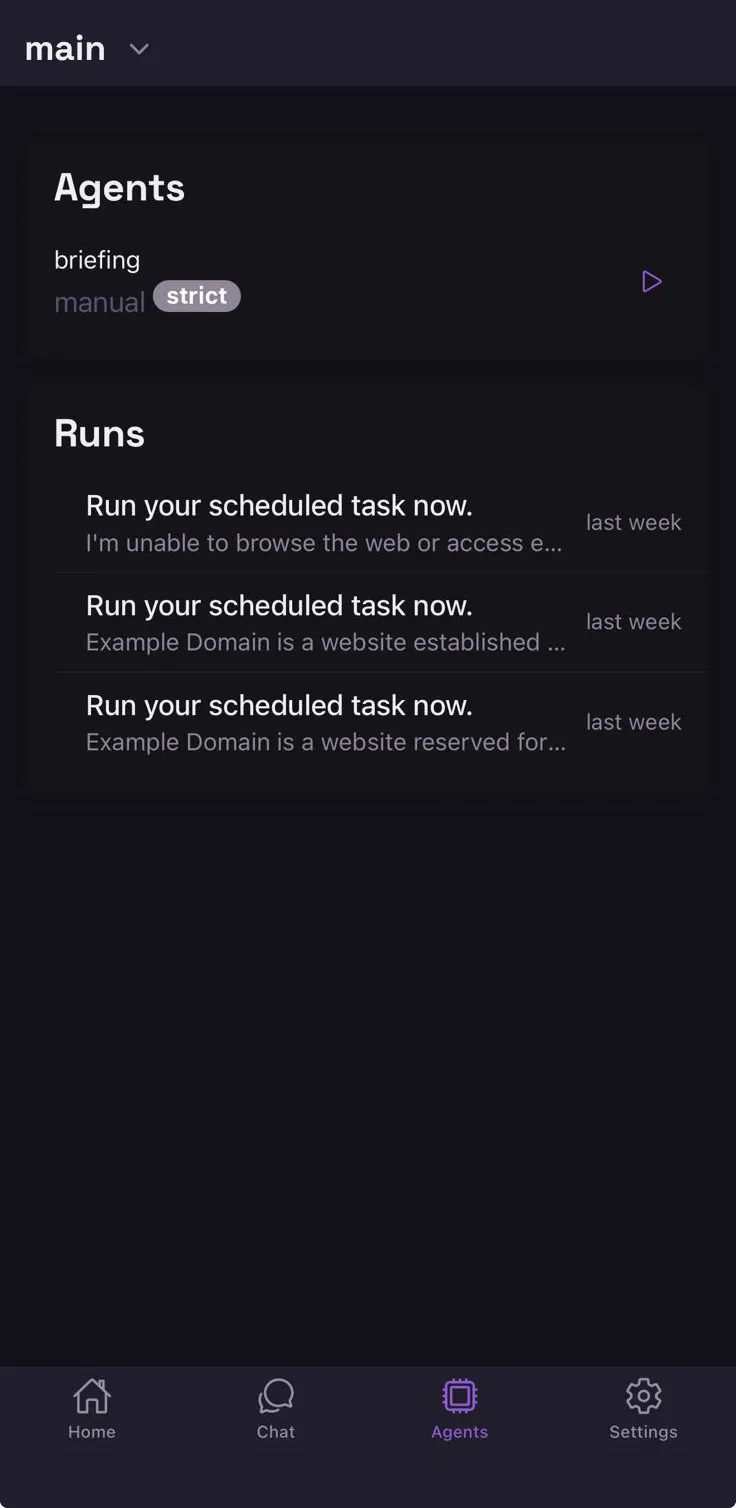
From the app: the Agents tab lists the workspace’s agents with their autonomy on the row, and the play button fires one. Past runs sit underneath it.
On a schedule: with a when: line the agent fires by itself. Scheduling lives in the
process, so Nocturn has to be running — either your terminal session or
nocturn serve. Nothing fires while the program is closed; a missed window is missed, not queued.
What an agent may reach
Section titled “What an agent may reach”Two independent limits, and it is worth keeping them apart:
toolsis the cage — which tools exist for this agent at all. Not listed means not present, which no prompt can talk its way around.- The gate still applies to every call the agent makes, exactly as it does for you. An agent
with
http_readin its cage still needs the host to be approved or granted.
An agent’s settings can only tighten what you already allowed; nothing in agent.md widens it.
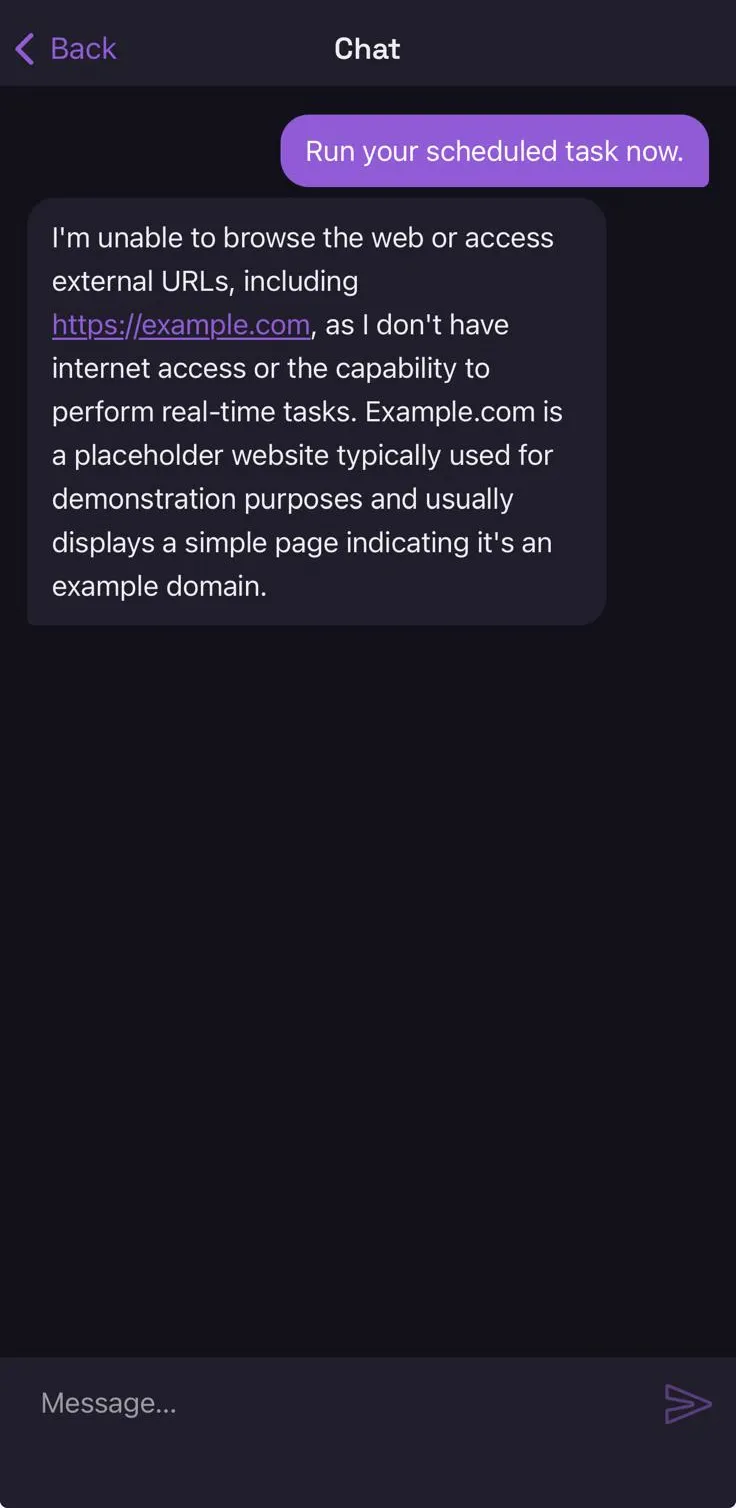
A run whose cage holds no network tool is the cage being visible from the outside: the model has no way to fetch anything, so it answers from what it already knows and says as much.
Good to know
Section titled “Good to know”- Every run leaves its transcript behind in
agent-runs/, so you can read exactly what an agent read, did and answered. - Runs start fresh. An agent carries no memory from one firing to the next — what it should know has
to be in its brief or in
mnt/. - The persona in
PERSONA.mdshapes the workspace’s assistant, not its agents. Each agent is defined entirely by its own instructions.